
Publications
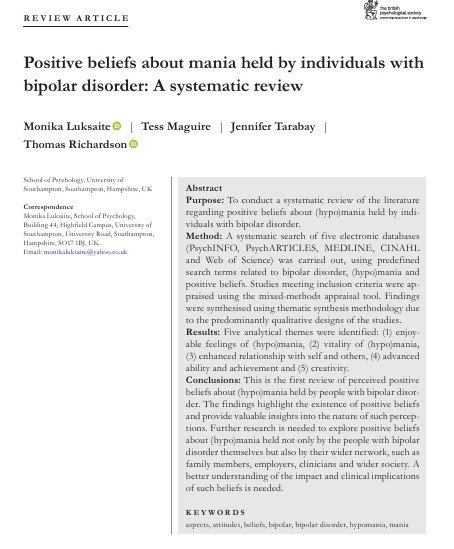
Positive beliefs about mania held by individuals with bipolar disorder: A systematic review (2026)
Monika Luksaite, Tess Maguire, Jennifer Tarabay, Thomas Richardson
Abstract
Purpose: To conduct a systematic review of the literature regarding positive beliefs about (hypo)mania held by individuals with bipolar disorder.
Method: A systematic search of five electronic databases (PsychINFO, PsychARTICLES, MEDLINE, CINAHL and Web of Science) was carried out, using predefined search terms related to bipolar disorder, (hypo)mania and positive beliefs. Studies meeting inclusion criteria were appraised using the mixed-methods appraisal tool. Findings were synthesised using thematic synthesis methodology due to the predominantly qualitative designs of the studies.
Results: Five analytical themes were identified: (1) enjoyable feelings of (hypo)mania, (2) vitality of (hypo)mania, (3) enhanced relationship with self and others, (4) advanced ability and achievement and (5) creativity.
Conclusions: This is the first review of perceived positive beliefs about (hypo)mania held by people with bipolar disorder. The findings highlight the existence of positive beliefs and provide valuable insights into the nature of such perceptions. Further research is needed to explore positive beliefs about (hypo)mania held not only by the people with bipolar disorder themselves but also by their wider network, such as family members, employers, clinicians and wider society. A better understanding of the impact and clinical implications of such beliefs is needed.

Book Chapter - 2024
Gently Bursting Bubbles and Raining on Parades: Working with Positive Beliefs About Mania and Overly Optimistic Thinking Patterns in Bipolar Disorder
Thomas Richardson, Tess Maguire & Monika Luksaite
A unique challenge for therapists working with bipolar disorder is that some individuals may be reluctant to stop getting manic, or ambivalent about this, due to perceived positive aspects of (hypo)mania. This chapter reviews the research on this area and discusses techniques in therapy, in particular from Cognitive Behavioural Therapy (CBT) and Motivational Interviewing (MI) when working with positive beliefs about mania, in order to enhance relapse prevention work. Another unique element of working with mania can be working with overly optimistic thinking patterns, especially during (hypo)mania, which can feel quite different from challenging the overly negative cognitions which therapists are used to working with in conditions such as anxiety disorders and depression. This chapter overviews therapy techniques and adaptations to CBT which can be used to challenge such thinking patterns, while maintaining a strong therapeutic relationship.
International Society for Bipolar Disorders Annual Conference Poster - 2024
Monika Luksaite, Tess Maguire & Thomas Richardson
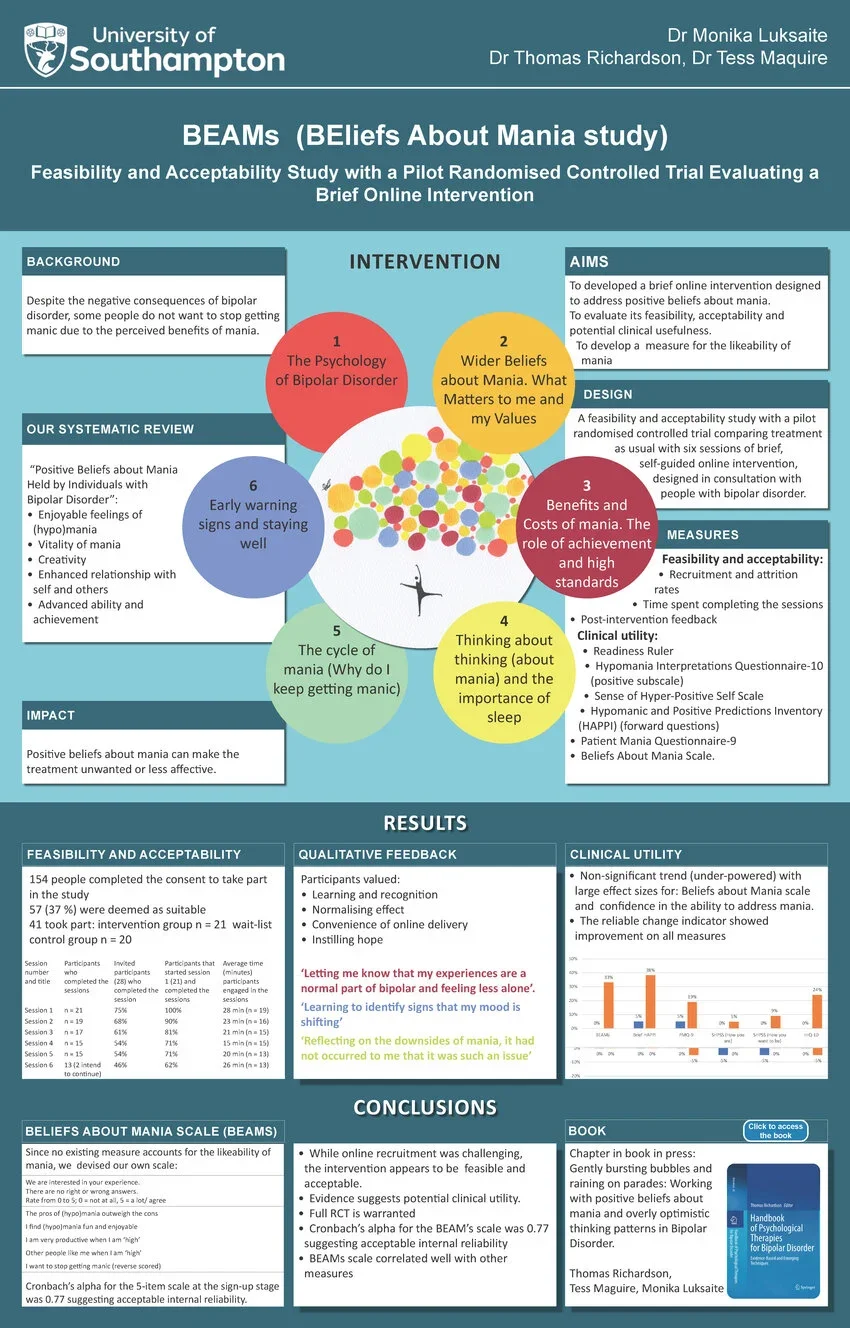
Despite the negative consequences of bipolar disorder, some people do not want to stop getting manic due to perceived benefits of mania. Therefore, we developed a brief online intervention designed to address positive beliefs about mania. This study evaluated the feasibility, acceptability and potential clinical usefulness of a brief online intervention.